
Divorce rates in the UK are falling — except among the over-50s. While younger couples are splitting up less than ever, separations among people aged 50 and over have been rising steadily for two decades. Lawyers and researchers have a name for it: grey divorce. You may not have heard the term before, but the trend is very real.
In 1990, couples aged 50 and over accounted for less than 10% of all UK divorces. Today that figure has risen to around 36%. For women over 65, the divorce rate has risen by almost 40% over the last two decades alone.
People are living longer. Unhappy marriages that once felt endurable for another decade can now stretch into three decades of retirement. The stigma around divorce — especially for older generations — has largely dissolved. And since 2022, no-fault divorce has made the legal process less combative and more accessible than ever before.
But here’s what the statistics don’t tell you: divorce after 50 in the UK is financially brutal in ways that younger couples simply don’t face. Your pension — perhaps your single most valuable asset — is on the table. So is the family home. And unlike a 35-year-old, you have far less time to rebuild what you lose.
This article won’t tell you whether to stay or go. What it will do is give you an honest look at the 9 financial realities of divorce after 50 in the UK, so if you’re facing this situation, you go in with your eyes open.
What Is Grey Divorce — and Why Is It Rising?
Grey divorce is simply the term used for divorce among couples aged 50 and over. It is sometimes called silver splitting. Whatever you call it, the reasons behind its rise are consistent: longer life expectancy, greater financial independence among women, the empty nest effect when children leave home, and a cultural shift away from staying in unfulfilling marriages out of duty.
Retirement is often the trigger point. Without the shared focus of raising children or building careers, couples can find themselves facing decades together with little common ground. For many, that is when the questions they have been quietly asking for years finally demand an answer.
9 Financial Realities of Divorce After 50 in the UK
1. Your Pension Is Probably Your Biggest Asset
In early-life divorce, the family home usually dominates proceedings. After 50, your pension often dwarfs everything else. A pension pot built over 35 or 40 years of working can be worth hundreds of thousands of pounds — and your spouse may have a legal claim on it.
In England and Wales, pensions accumulated during a marriage are generally treated as matrimonial assets, even if contributions began before the marriage. Many people don’t realise this until it’s too late.
2. Pensions Don’t Automatically Split 50/50
The courts aim for a fair outcome — which doesn’t always mean equal. There are three main options for dealing with pensions on divorce after 50 in the UK:
- Pension sharing order — A percentage of one partner’s pension is transferred to the other, creating a completely separate pension entitlement. This is the cleanest solution and the most common in later-life divorce.
- Pension offsetting — The pension is offset against other assets. One partner keeps the pension; the other receives a larger share of the house equity or savings. Be careful here — a house and a pension are very different things, and getting this wrong can leave you short of income in retirement.
- Pension earmarking — A portion of one partner’s pension payments is redirected to the other at retirement. Less common and generally less favoured because it keeps the two parties financially tied together for years.
3. Defined Benefit Pensions Are Especially Complex
If either of you has a final salary or defined benefit pension — common among public sector workers, teachers, NHS staff and civil servants — the situation is more complex than it appears. The figure shown on your pension statement is rarely the true value of what you would receive in retirement income.
In these cases, courts increasingly instruct a Pensions on Divorce Expert (PODE) — usually an actuary — to calculate a fair division based on retirement income rather than just the headline transfer value. This costs money, but getting it wrong costs far more.
4. You Have Far Less Time to Recover
A 40-year-old who loses half their assets in a divorce has 25 working years to rebuild. A 65-year-old may have five years, or none. That asymmetry changes everything about how you need to approach the settlement. Every decision carries more weight when you are older, and mistakes are harder — sometimes impossible — to undo.
This is not a reason to avoid divorce if it is the right decision. It is a reason to take professional advice before agreeing to anything.
5. The Family Home Brings Its Own Complications
Deciding what happens to the family home is often the most emotionally charged part of any divorce — and after 50 the financial stakes are particularly high. The main options are:
- Sell and split — The cleanest solution financially, though both parties need somewhere to live on potentially reduced budgets.
- One partner buys the other out — Possible if sufficient assets exist, but harder in later life as mortgage lenders become more restrictive about age.
- Deferred sale — One partner remains in the home until a specific event (such as death, remarriage, or a fixed date) before the property is sold and proceeds divided.
Downsizing is a reality for many people after divorce after 50 in the UK. Our guide on the true costs of downsizing your home is worth reading before you make any decisions.
6. The Hidden Costs Will Surprise You
Beyond the headline settlement, divorce after 50 in the UK comes with a raft of costs that many people don’t anticipate:
- Legal fees — The average cost of a contested divorce in England and Wales is around £14,500. Mediation is significantly cheaper — typically £600–£1,000 per person — and often produces better outcomes.
- Pension valuations — Getting a pension properly valued for divorce proceedings requires a specialist and costs money. Factor this in early.
- Two households — Running two homes instead of one dramatically increases living costs, potentially by 30–40%. This is a permanent change to your financial position, not a temporary one.
- Care costs — After divorce, different rules may apply regarding care funding assessments. Always take specialist advice if care is a consideration for either party.
- Tax implications — Capital gains tax rules on assets transferred between divorcing couples have changed in recent years. Always take specialist advice before transferring property or investments.
| ⚠ Watch out for rushed settlements Agreeing to a financial settlement quickly to ‘get it over with’ is one of the most common and costly mistakes in divorce after 50. Pension decisions in particular are very difficult to reverse once agreed. Take your time and get proper professional advice first. |
7. Your State Pension Is Not Divided — But It May Still Be Affected
Your State Pension cannot be shared on divorce the way a private pension can. However, divorced people may be able to use their former spouse’s National Insurance record to increase their own State Pension entitlement in certain circumstances. This is worth checking with the Pension Service, particularly if you have gaps in your own NI record.
8. Your Will and Power of Attorney Need Updating Immediately
Many people don’t realise that divorce does not automatically revoke your will in England and Wales — or your Lasting Power of Attorney. If you die during the separation process, before the final order is granted, your existing will may still benefit your estranged spouse.
Update your will as soon as you decide to separate. Also review the beneficiaries on your pension and life insurance policies — these sit outside your will entirely and pass directly to whoever is named on them, regardless of what your will says.
If you haven’t yet set up a Lasting Power of Attorney, our guide on power of attorney explains why it is one of the most important legal documents you can have in later life.
9. Your Benefits Entitlement Changes — Sometimes in Your Favour
As a single person, your financial picture looks different — and not entirely in a negative way. As a newly single person you may become entitled to:
- Council Tax Reduction — Single occupants receive a 25% council tax discount automatically.
- Pension Credit — If your income falls below the qualifying threshold as a single person, you may now qualify. Our guide on pension credit explains exactly what it is worth and how to claim.
- Housing Benefit — If you move into rented accommodation, you may be eligible.
| 💡 Check your entitlement Use the free benefits calculator at GOV.UK or Citizens Advice after any change in circumstances. Many people discover they are newly eligible for help they didn’t qualify for as a couple. |
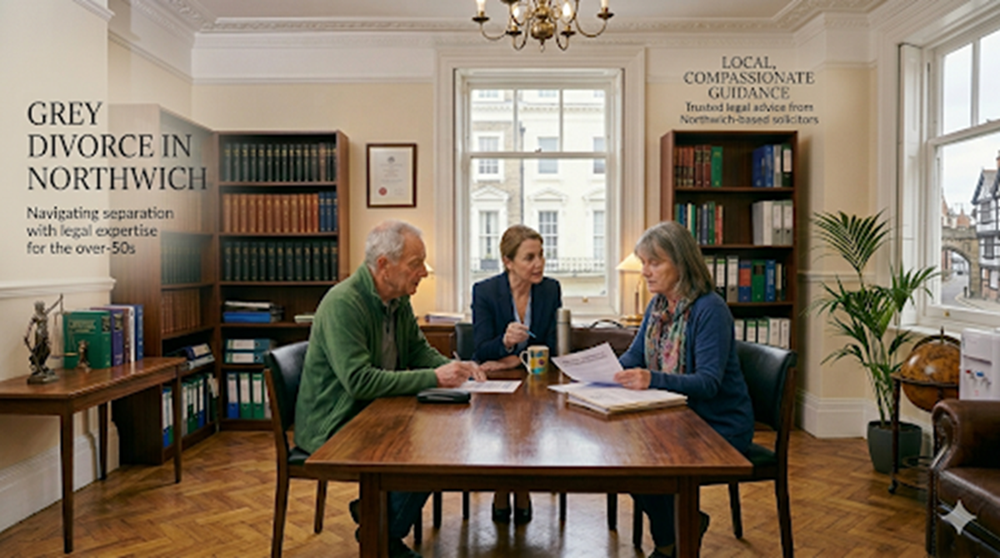
Practical Steps If You Are Considering Divorce After 50 in the UK
- Get a full picture of all assets — pensions, savings, property, investments. Both parties must disclose everything under UK law.
- Consult a specialist family lawyer with experience in later-life divorce before agreeing to anything.
- Consider mediation first — it is cheaper, faster, and keeps both parties in control of decisions.
- Get independent financial advice from a qualified adviser experienced in divorce and pension splitting.
- Update your will immediately — do not wait for the final order.
- Change beneficiaries on your pension and life insurance policies.
- Check your State Pension position and whether you can use your former spouse’s NI record.
- Review your benefits entitlement as a single person — you may be entitled to more than you think.
Your Questions Answered
| Q: What is grey divorce? Grey divorce is the term used for divorce among couples aged 50 and over. It is rising in the UK — couples over 50 now account for around 36% of all divorces, up from less than 10% in 1990. Divorce after 50 in the UK typically involves more complex financial issues than earlier-life divorce, particularly around pensions, property and long-term retirement security. |
| Q: What happens to my pension if I divorce after 50 in the UK? Pensions built up during a marriage are generally treated as matrimonial assets in England and Wales and can be divided on divorce. The main options are a pension sharing order, pension offsetting, or pension earmarking. A specialist solicitor and independent financial adviser should be consulted before agreeing to any pension settlement. |
| Q: Can I claim my ex-spouse’s State Pension after divorce? You cannot directly claim your ex-spouse’s State Pension, but in some circumstances divorced people can use their former spouse’s National Insurance record to increase their own State Pension entitlement. Contact the Pension Service for personalised guidance. |
| Q: Is mediation cheaper than going to court for divorce after 50? Yes, significantly. Mediation typically costs £600–£1,000 per person, compared to average legal fees of around £14,500 for a contested divorce. Mediation also tends to be faster and gives both parties more control over the outcome. |
| Q: Does divorce affect my will automatically? In England and Wales, divorce does not automatically revoke your will until the final order is granted. You should update your will and Lasting Power of Attorney as soon as you decide to separate — not after the process is complete. |
The Bottom Line on Divorce After 50 in the UK
Divorce after 50 in the UK is becoming more common — and for understandable reasons. People deserve to be happy in their later years, and the legal process is now less adversarial than it has ever been.
But the financial consequences of separating after decades of marriage are serious and demand careful thought. The pension, the home, the living costs, the legal fees, the will — all of it needs to be addressed properly. The good news is that with the right legal and financial advice, most people do find a way through.
The key is not to rush, not to make decisions based on emotion alone, and not to agree to anything — especially regarding pensions — without taking proper professional advice first.
If you found this guide useful, please share it with someone who might be facing the same situation. And if you have questions, our guides on Power of Attorney and Pension Credit may also be helpful next reads.
| Thinking of Downsizing? Here’s What It Really Costs Power of Attorney: What Every Pensioner Needs to Know Pension Credit: Are You One of the Millions Missing Out? |
| 🔗 Divorce and Pensions: Citizens Advice — Divorce: National Family Mediation: Unbiased — Find a Financial Adviser: |